
Memory Score
Know if your message is remembered
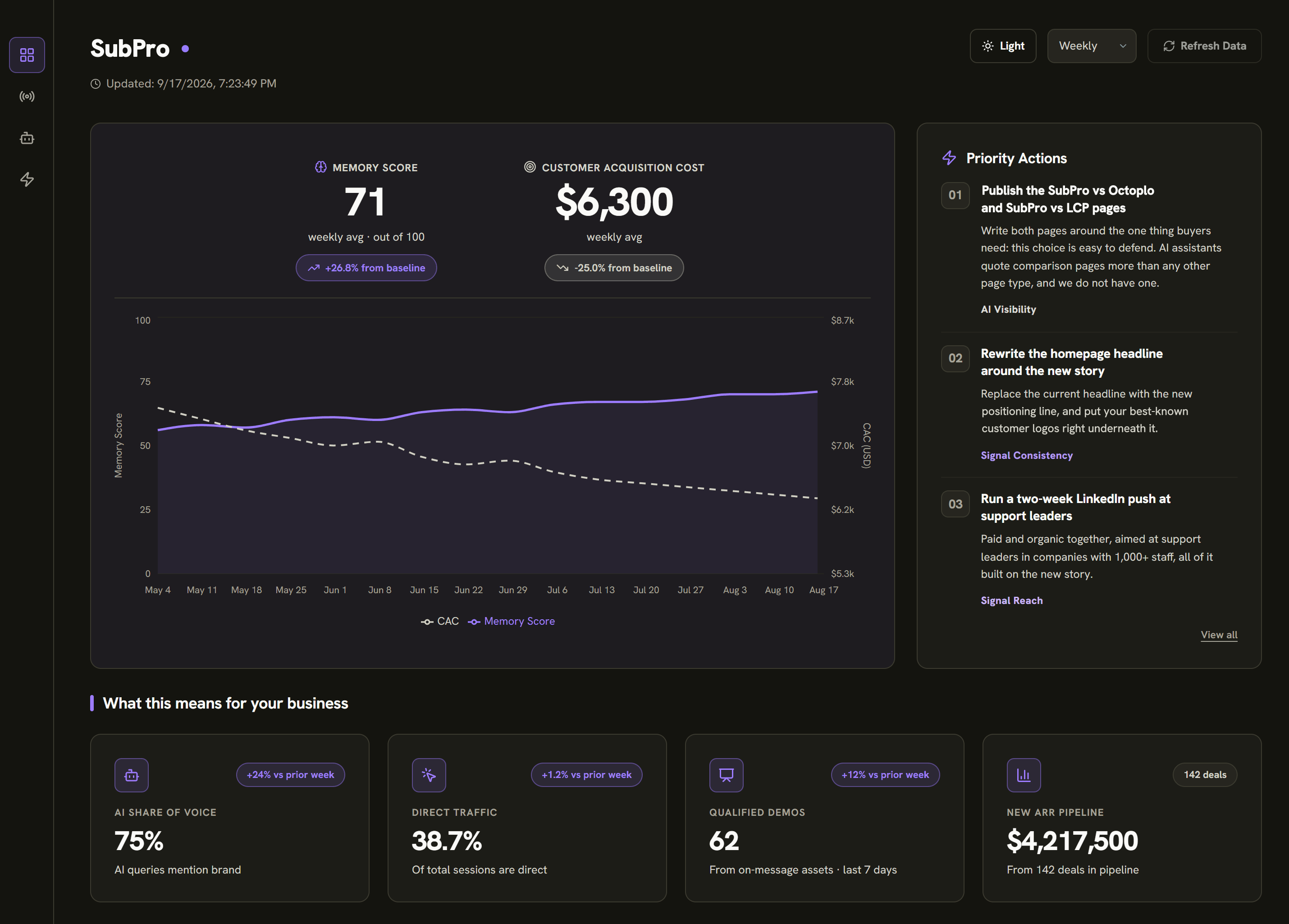
Memory Score is our measure, from 0 to 100, of how well buyers and AI assistants remember the message you locked in Positioning. It updates daily, reports a weekly average and sits next to a priority financial metric like customer acquisition cost (CAC).
Three signals
What are the three signals?
Consistency and reach are worth up to 30 points each, AI visibility up to 40. Together they make the score out of 100.
S1 · 30 points
Signal consistency
How much of what you publish carries your message.
S2 · 30 points
Signal reach
Whether more people see your on-message content.
S3 · 40 points
AI visibility
Whether AI assistants name you, how high, with the right message.
How each signal works
S1Signal consistency
We read the last 30 days of your pages, posts and emails and check each piece for your message. Any other story that fills 15% or more of your content is a competing message, and it costs points.
In your dashboard
- Share of pages and posts on your message, by channel
- Every competing message, named by topic
- Each piece, with a one-line reason for the call
S2Signal reach
We count views of your on-message content across LinkedIn, YouTube and other social networks, plus email opens. The score rewards growth against the previous 30 days, not size.
In your dashboard
- On-message views per channel, by month or week
- The channel that carried the growth
- Growth against the previous period
S3AI visibility
We ask ChatGPT, Claude and Gemini the questions your buyers ask, once from what each model learned and once with web search. We track whether you're named, where you rank and whether it's for your message.
In your dashboard
- Mention rate across ChatGPT, Claude and Gemini
- Your average position vs competitors
- The full answer behind every mention, with its sources
- Your rank with and without web search
Recommendations
What moves Memory Score?
A recommendation engine reads the three signals and ranks what to do next. Each action belongs to one signal and is ranked High, Moderate or Low by how weak that signal is. A sharp fall moves it up a level.
- High
Rewrite the homepage headline around the locked message
S1 - High
Publish the comparison pages AI assistants quote most
S3 - Moderate
Add FAQ markup to the pages that answer category questions
S3 - Low
Put the new message on the sales deck cover slide
S1
FAQ
Does Memory Score predict CAC or other financial metrics?
No. It is shown next to a priority financial metric, like CAC, so you can see how the two move week by week. Prediction is not a claim we make today.
Which AI assistants are checked?
ChatGPT, Claude and Gemini, each asked the same questions twice: once without letting them look anything up (training recall) and once with web search on. Up to eight questions cover your category and your message, with no brand name in them.
Who owns the score and the outputs?
You do. The message, the recommendation card, the actions and every score are yours and remain so after the engagement ends.
How is this different from an SEO or GEO tool?
A tool reports whether you were mentioned. Memory Score also measures whether your own content carries one message and whether more people are seeing it. And a senior expert reads it and decides what to change.
When do we get our first score, and how often is it updated?
Your baseline is set at lock-in, once Positioning has locked your message, usually within 8 weeks. Your first score arrives the same day. From then on the score refreshes daily, the headline shows the weekly average and an expert reviews it every week. The message it measures against is revisited at each quarterly review, in line with AI model updates.
Can the score go down?
Yes. Off-message content, a competing message, slower growth in on-message views or losing an AI mention all cost points. A sharp fall moves the related actions up your to-do list.